Part 1. Purpose and Overview
This page examines a 2010 mortality case at Toride Kyodo Hospital (now JA Toride Medical Center) in Ibaraki, Japan, focusing on contradictions between official explanations by the hospital, police, and administrative authorities and the underlying procedures, documents, and primary records. The core question is: at which points, and by which actors, did the process deviate from statutory norms governing death certification and registration.
Three institutional layers are implicated simultaneously:
- Medical layer: handling of death certification (death certificate vs. postmortem certificate), hospital billing, and non‑disclosure of the September 2010 insurance ledger (receipts).
- Police / judicial layer: explanation that a judicial autopsy was performed, the format and handwriting of the postmortem certificate, and collection of a 50,000 JPY “judicial autopsy fee.”
- Administrative layer: completion and submission of the death notification, and shifting explanations by the Legal Affairs Bureau and municipal office regarding preservation, destruction, and transfer of the integrated A3 record.
These are not isolated clerical errors. Taken together, they suggest that the core state process of recognizing, certifying, and registering a death may have been distorted through the coordinated or sequential actions of multiple institutions. To allow international investigative readers to grasp the structure quickly, the page is organized into six parts:
- Part 1: Purpose and overview (this section)
- Part 2: Factual chronology (2010–2026) and involved actors
- Part 3: Analysis of key documents (postmortem certificate, autopsy fee, hospital invoice, death notification)
- Part 4: Statutory framework and cross‑sector contradictions
- Part 5: Key questions and investigative hypotheses
- Part 6: Primary materials and call for independent investigation
Part 2. Factual chronology (2010–2026) and involved actors
2‑1. 12 September 2010: In‑hospital death and request for judicial autopsy
- Location / event: The patient died in Toride Kyodo Hospital. Head CT documented an acute subdural hematoma as the terminal event.
- Family response: The family declined the hospital’s proposed pathological autopsy and explicitly requested a state‑mandated judicial autopsy.
- Police involvement: Detective Section Chief Noriyuki Sawamura (Toride Police Station) handled the case. Interviews with the family were limited; he later stated that “based on the postmortem examination, the case will proceed to judicial autopsy.”
2‑2. 14 September 2010: Delivery of postmortem certificate and collection of “judicial autopsy fee”
- Telephone call: In the afternoon, Detective Sawamura called the family home, asking about the patient’s occupation and industry—data required for the death notification—and stating that he had advanced a 50,000 JPY judicial autopsy fee and would bring a receipt.
- Body transport: The remains were transported to the family home by a funeral company.
- Police visit: In the evening, Sawamura arrived in a private vehicle with another person and did not present a police ID.
-
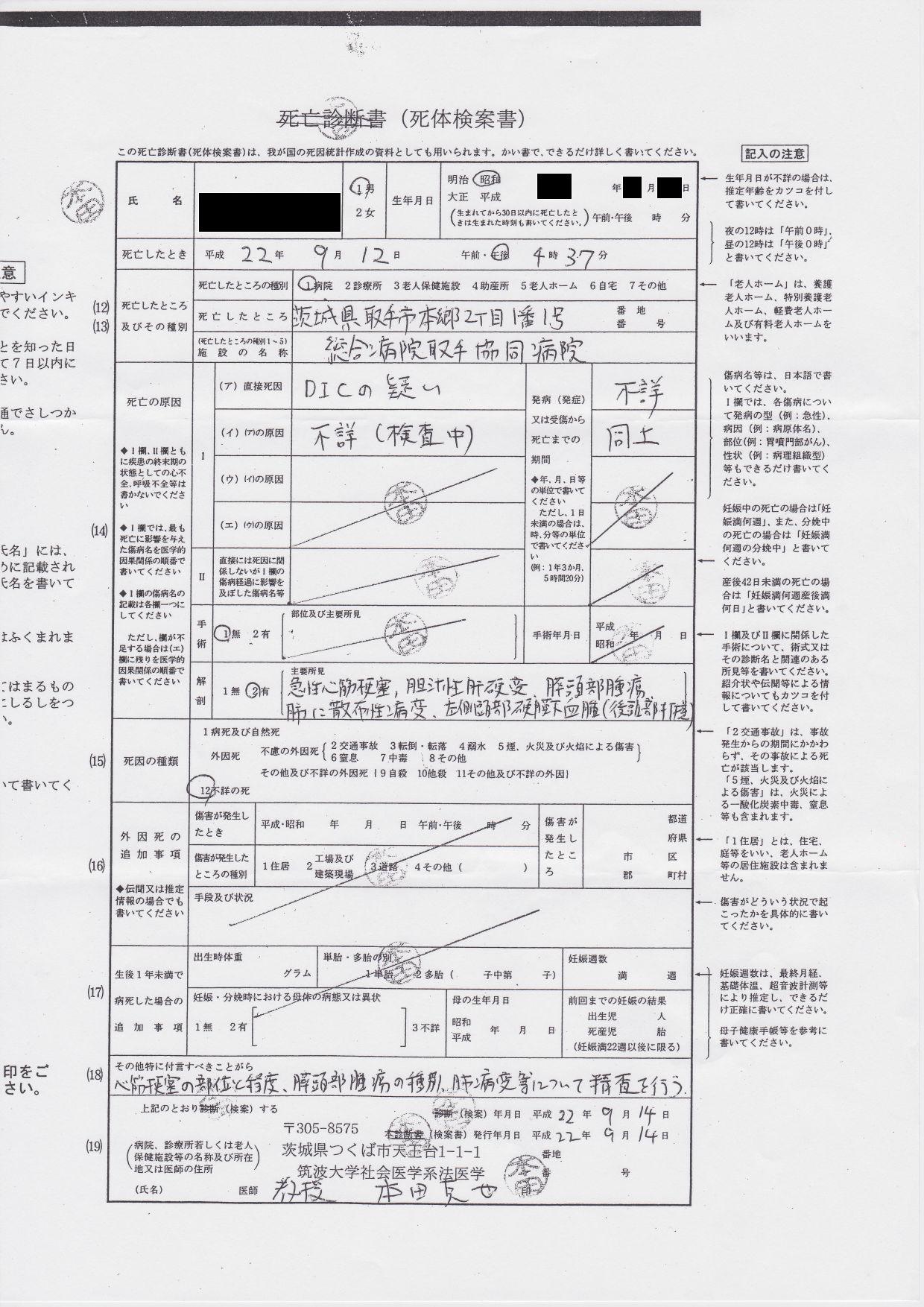
He handed over an A4 photocopy of a postmortem inspection certificate without the left‑hand death notification section,
stating that “this was written by Professor Katsuya Honda of the University of Tsukuba, Department of Forensic Medicine.”
-
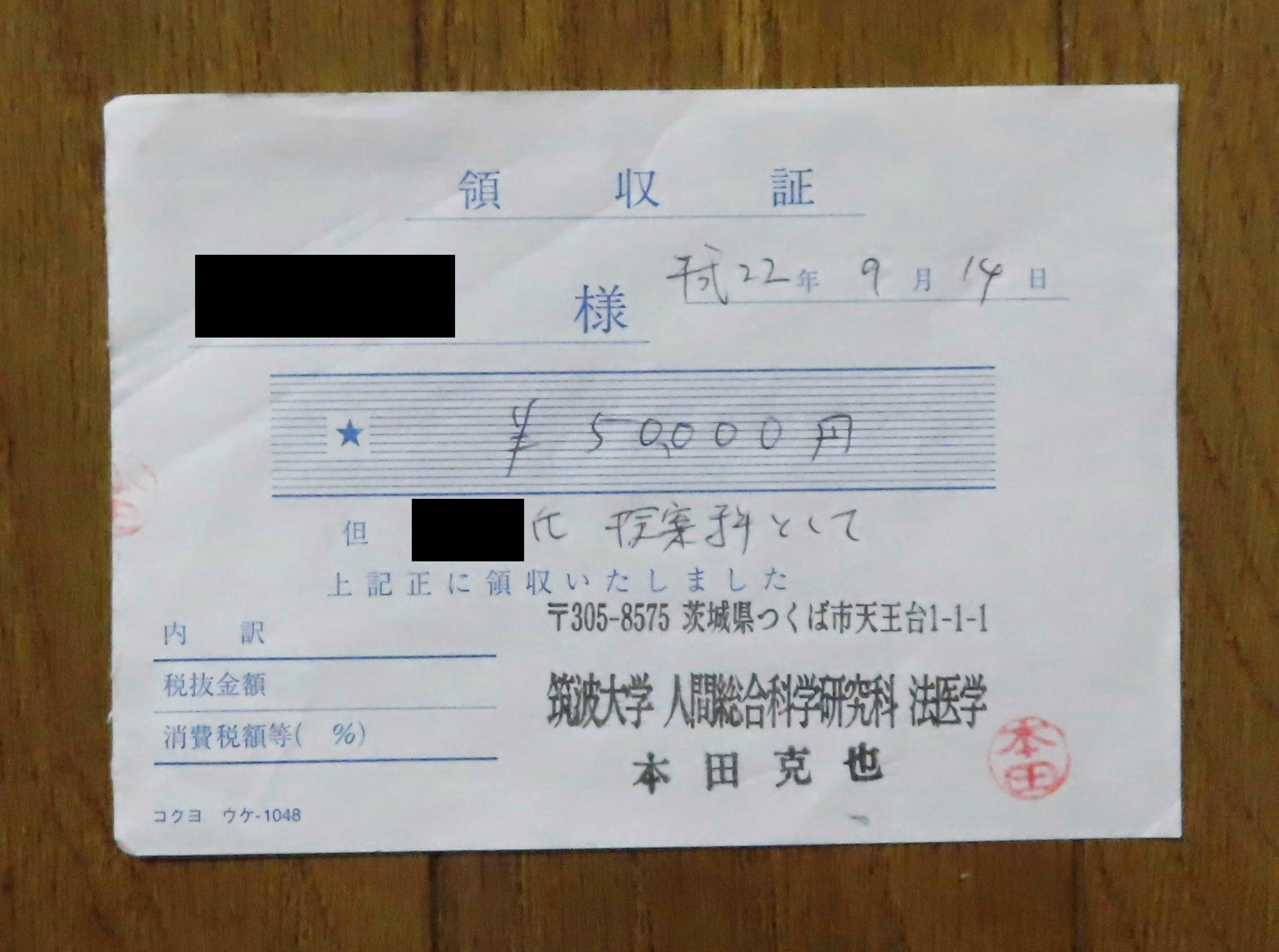
He also presented a handwritten receipt for a 50,000 JPY “judicial autopsy fee”, and the family paid this amount.
- Summary of his explanation:
- He had attended the judicial autopsy.
- No clear evidence of medical error or criminal conduct was found.
- The cause of death was “suspected DIC” with severe myocardial infarction.
- An acute subdural hematoma was acknowledged, but no mention was made of head trauma.
- The appropriateness of medical care was said to be “under examination.”
2‑3. 2010–2011: Non‑disclosure of the September 2010 ledger and hospital invoice
- Ledger non‑disclosure: The September 2010 insurance ledger (receipts) was neither disclosed nor billed initially.
- The family requested disclosure and mailing of the September ledger and invoice; the hospital sent only a copy of the invoice, not the ledger.
- During evidence‑preservation preparations, the family’s attorney argued that “case law does not recognize a right for next‑of‑kin to access the ledger” and removed it from the preservation list.
- Subsequent attempts to obtain the ledger at the municipal counter were refused.
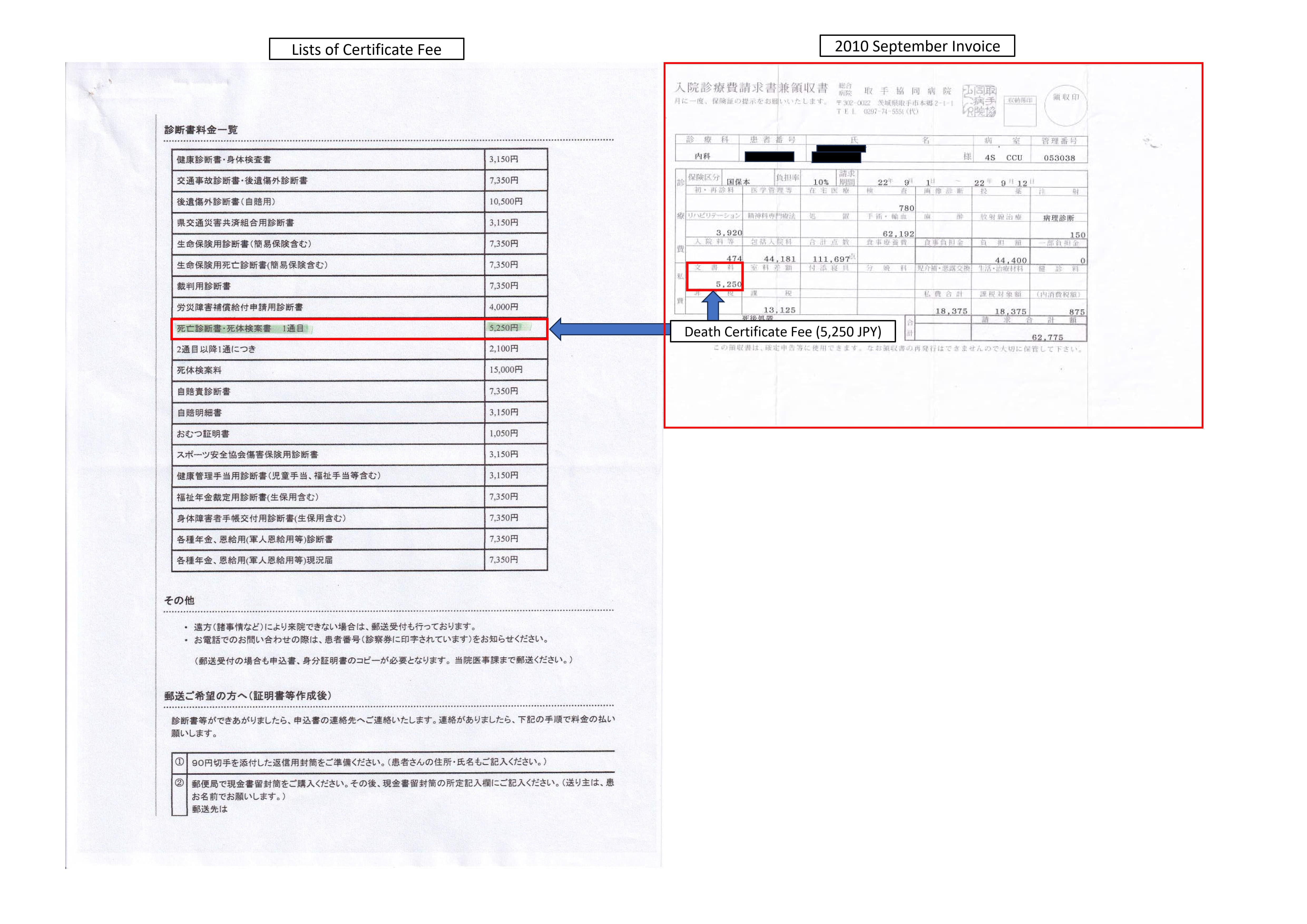
- Hospital invoice: The September 2010 invoice contained a line item “Private / documentation fee: 5,250 JPY.” Cross‑checking fee schedules from related hospitals shows that this amount corresponds to a death certificate fee.
2‑4. After 2010: No death notification submitted by the family, but registry removal completed
- None of the three family members wrote or submitted a death notification, yet the patient was removed from the family registry.
- The registry lists the mother as the notifier, which conflicts with the family’s recollection and actions.
2‑5. 2026: Acquisition of the death notification and shifting administrative explanations
- First visit to Legal Affairs Bureau (11 May 2026): At the Mito District Legal Affairs Bureau (Ryugasaki Branch), staff stated that the integrated A3 death notification and medical certificate had been “destroyed after a five‑year retention period” and that “no record remains anywhere.” This conflicts with the options set out in the Family Registration Act regulations, which provide for either destruction or transfer.
- Second visit (18 May 2026): On a follow‑up visit, when asked for the destruction decision, responsible official, date, and destination of any duplicate, staff changed their explanation to “it was destroyed but also transferred to the municipal office.” When asked whether “destroyed” had been a mistake, they replied that it was not, and that it had been “destroyed and transferred,” a formulation that does not match the statutory categories.
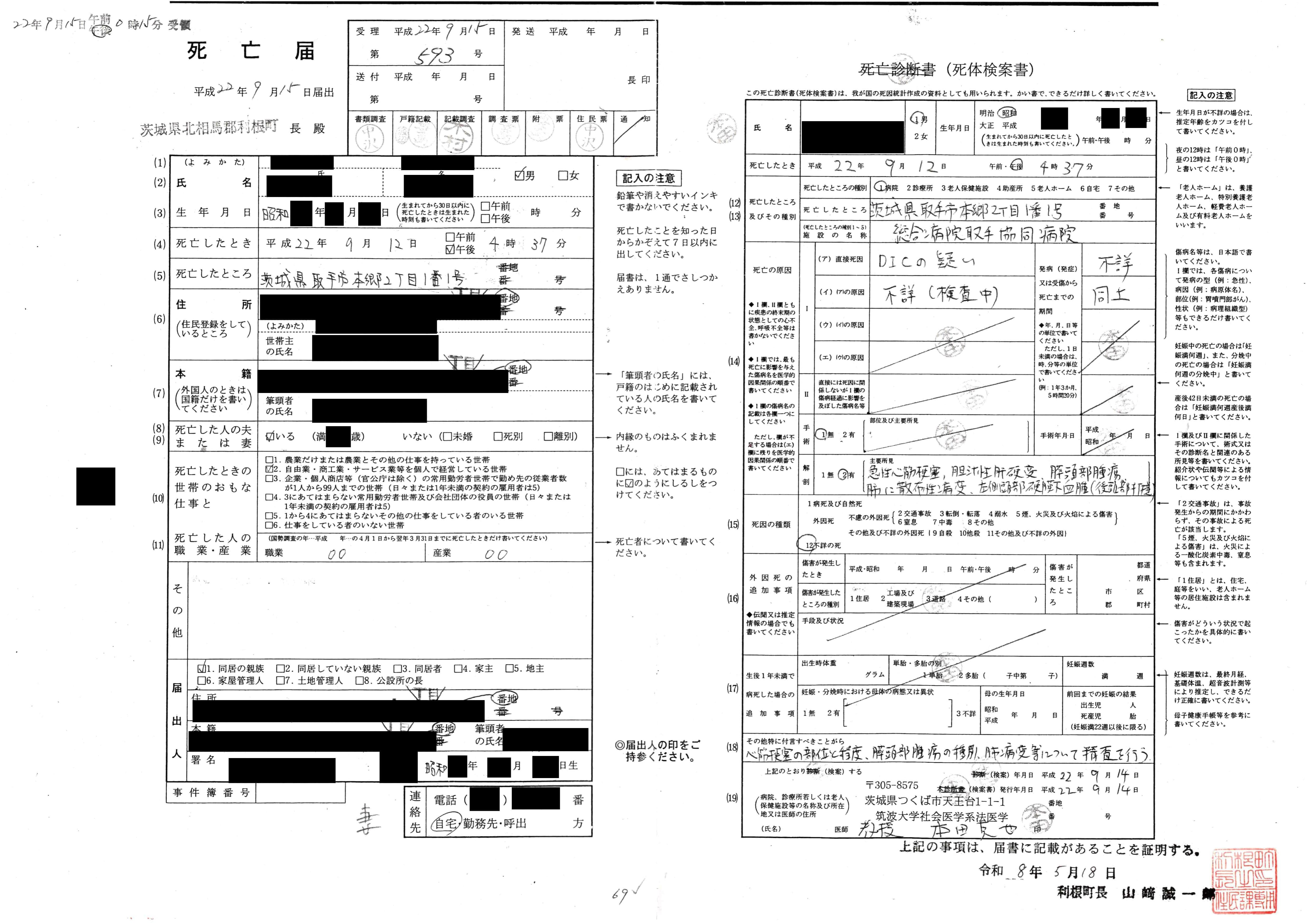
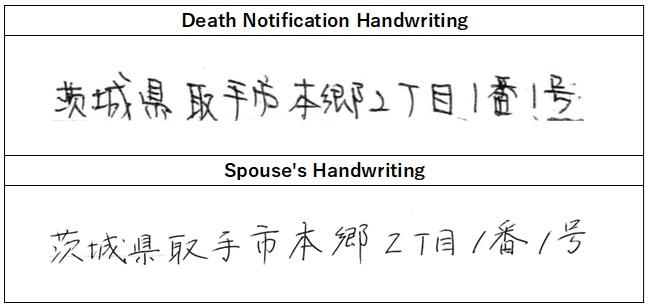
- Municipal office: At the municipal counter, the family obtained the certified death notification record. The handwriting in the notifier section clearly differs from the mother’s handwriting, and the occupation/industry fields contain mechanical codes such as “00.” Handwriting comparison of the address field also shows that a third party, not the family, completed and submitted the notification.
-
Part 3. Key documents: form, content, and statutory consistency
3‑1. Postmortem certificate: format anomalies and handwriting issues
- Format: The certificate handed over by the police was an A4 photocopy, not an original. The left‑hand death notification section, which should form a single A3 integrated sheet with the medical certificate, was missing.
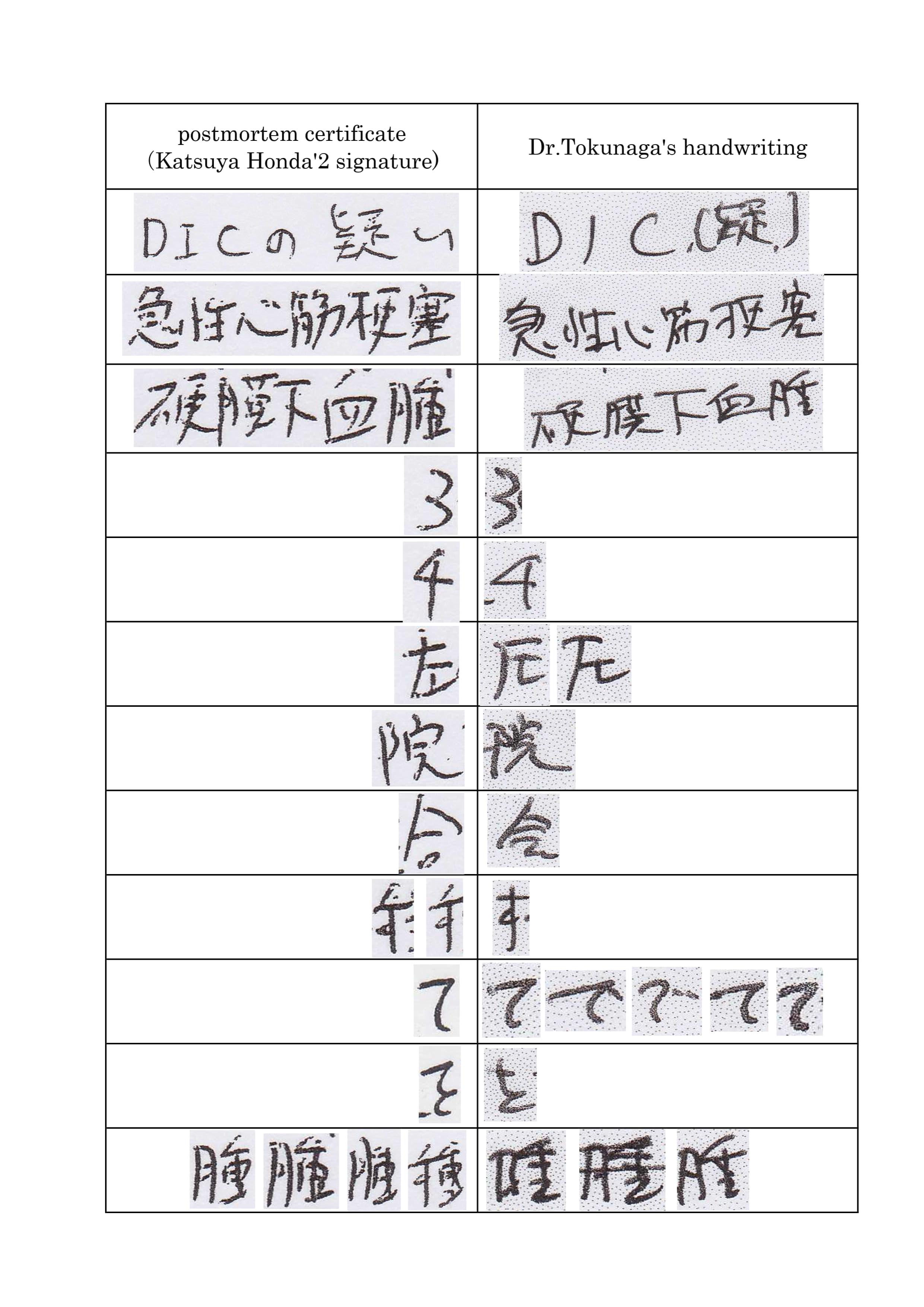
- Handwriting: The signature block bears the name “Professor Katsuya Honda, University of Tsukuba, Department of Forensic Medicine.” However, the handwriting closely resembles that of the hospital’s cardiology chief, Dr. Takeshi Tokunaga, suggesting that the named signatory and the actual writer may differ.
-
3‑2. 50,000 JPY “judicial autopsy fee”: statutory inconsistency
- The family received a handwritten receipt for a 50,000 JPY judicial autopsy fee from Detective Sawamura and paid this amount.
- Under Japanese law, judicial autopsies are funded by the national treasury; there is no mechanism for billing families.
- There is likewise no statutory procedure for a police officer to “advance” such a fee personally and then collect reimbursement from the family.
- This raises serious questions about the nature of the payment and whether it corresponds to any formally registered autopsy.
-
3‑3. Hospital invoice “documentation fee 5,250 JPY”: alignment with death certificate
- The September 2010 hospital invoice includes a “Private / documentation fee: 5,250 JPY.”
- Fee schedules from related institutions show that this amount corresponds to a death certificate (死亡診断書) fee.
- By statute, a death certificate and a postmortem inspection certificate (following judicial autopsy) cannot both serve as the primary death certification for the same case.
- Yet:
- Police explanations: a judicial autopsy was performed and a postmortem certificate issued.
- Hospital billing: a fee consistent with a standard death certificate was charged.
- This raises the question of which document was actually used as the official basis for registry processing.
-
3‑4. Death notification: handwriting and notifier mismatch
- The family did not write or submit a death notification, yet the registry shows the patient as removed.
- The 2026 certified death notification lists the mother as notifier, but the handwriting of the address and name fields clearly differs from her known handwriting.
- The occupation and industry fields contain mechanical codes such as “00,” entered without consultation with the family.
- These features objectively support the conclusion that a third party completed and submitted the notification under the mother’s name. Legally, this would correspond to forgery and use of a private document with a seal (subject to limitation periods).
Part 4. Statutory framework and cross‑sector contradictions
4‑1. Medical layer: certificates, ledger, and billing
- A fee consistent with a death certificate was billed, while the police delivered a postmortem certificate purportedly linked to a judicial autopsy.
- The September 2010 insurance ledger has been consistently withheld by both the hospital and administrative offices.
- This combination obscures which document was actually used as the official death certification and how the case was coded in the health insurance system.
4‑2. Police / judicial layer: autopsy status and procedural deviations
- Police stated that a judicial autopsy had been performed.
- The postmortem certificate is formally incomplete (A4 copy, missing death notification section), and the handwriting suggests authorship by a treating clinician rather than an independent forensic specialist.
- The 50,000 JPY “judicial autopsy fee” collected from the family has no basis in statutory funding rules.
- The fact that police phoned the family to obtain occupation/industry information—later appearing as mechanical codes in the notification—indicates direct involvement in the death notification process.
4‑3. Administrative layer: preservation, destruction, and transfer narratives
- The Legal Affairs Bureau initially stated that the integrated A3 record had been “destroyed” and that no record remained.
- After challenge with statutory provisions, the explanation shifted to “destroyed but transferred to the municipal office.”
- Under the Family Registration Act regulations, “destruction” and “transfer” are mutually exclusive options; “destroyed and transferred” is not a recognized category.
- The eventual issuance of the certified death notification by the municipal office shows that the initial “destruction” explanation was inconsistent with the actual record status.
4‑4. Structural anomaly across three institutional domains
- The format and handwriting of the postmortem certificate, the non‑statutory autopsy fee, the death‑certificate‑level documentation fee, the third‑party death notification, and the shifting explanations by the Legal Affairs Bureau cannot easily be explained as isolated mistakes.
- Instead, they suggest a structural anomaly spanning hospital, police / judicial, and administrative systems, which nonetheless produced a single, apparently coherent death record in the registry.
- This cross‑sector configuration is what gives the case broader investigative significance beyond a single medical incident.
Part 5. Key questions and investigative hypotheses
The case raises a set of interrelated questions that can guide independent investigation:
- Authenticity of the postmortem certificate: Was the A4 postmortem certificate delivered by police produced through a formal forensic process? How did the mismatch between the named signatory and the handwriting arise?
- Actual status of the judicial autopsy: Was a judicial autopsy in fact performed? If so, what was its scope, purpose, and formal reporting pathway?
- Purpose of the 50,000 JPY “judicial autopsy fee”: Why was a non‑statutory family payment collected, and how—if at all—does it relate to any official autopsy registration or funding stream?
- Nature of the 5,250 JPY documentation fee: Does this line item represent a death certificate, a postmortem certificate, or some other document? How was it used in subsequent administrative processing?
- Motivation for third‑party completion of the death notification: Who completed and submitted the notification under the mother’s name, under whose authority, and for what purpose?
- Reasons for shifting administrative explanations: What institutional factors led the Legal Affairs Bureau to alternate between “destroyed” and “transferred” narratives?
- Absence of independent review over 16 years: Despite multiple contradictions, why was no independent inquiry initiated by domestic oversight bodies or professional organizations?
Together, these questions point to a broader issue: how official death records are constructed, and at which points they can be altered or fabricated within existing institutional frameworks.
Part 6. Primary materials and call for independent investigation
6‑1. Primary materials (public versions)
- Postmortem inspection certificate (A4 copy, no death notification section)
postmortem_certificate.pdf - Judicial autopsy fee receipt (50,000 JPY)
judicial_autopsy_fee_receipt.pdf - Clinical explanation sheet (cardiology)
explanation_sheet_0912.pdf - Handwriting comparison: postmortem certificate vs. treating physician
handwriting_comparison.pdf - Death notification (certified extract; evidence of third‑party completion)
certified_death_notification_redacted.pdf - September 2010 hospital invoice (documentation fee 5,250 JPY)
september_invoice.pdf - Fee schedule from related hospital
document_fee_list.pdf
All public files are redacted for personal data. Original documents can be verified via published SHA‑256 hashes. See Technical Notes for the hash register.
6‑2. Call for independent investigation
This case extends beyond a single medical error. It sits at the intersection of death certification, judicial autopsy, family registry, and administrative record‑keeping. Primary materials have been preserved and organized so that external teams can begin verification without reconstructing the archive from scratch.
What is missing is an independent, conflict‑free investigative process. Journalists, legal practitioners, forensic specialists, and oversight bodies interested in examining this case can make contact via the contact page, using high‑anonymity channels (e.g. Session) where necessary. Upon agreement on secure data‑exchange methods, additional non‑public materials can be provided.